How to Use a United Status Challenge
United status challenges let you earn Premier status faster by concentrating your flying into a short window. Here's how they work and when to request one.
Quick Answer
A United status challenge lets you earn Premier status by meeting a compressed PQP or segment goal within 90 days — these targeted offers are not publicly listed, but you can request one by calling MileagePlus customer service, especially if you hold status on a competing airline.
A United status challenge is a targeted offer that lets you earn Premier status faster by flying a set number of segments or earning a set amount of PQP within 90 days. It's not publicly advertised, which means most flyers don't know it exists. If you're new to United, switching from another airline, or coming back after a lapse, a challenge is often the most efficient path to status.
What a Status Challenge Is
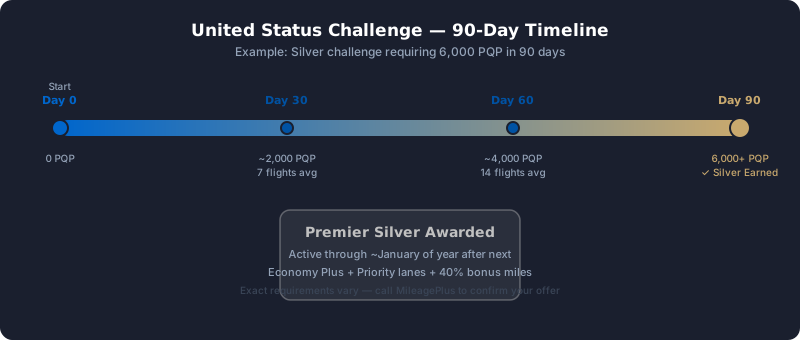
Instead of spending a full calendar year accumulating PQP and PQF toward a tier, a status challenge sets a compressed goal: earn [X] PQP or fly [X] segments within 90 days, and receive a status award at the end. The specific requirements vary by offer and by the tier you're targeting.
Challenges are typically offered by United to:
Travelers who previously held United Premier status and let it lapse
Travelers with elite status on a competing airline (status match situation)
Targeted MileagePlus members who have recently started flying United after a gap
United doesn't publish a standard challenge program the way some carriers do. The offers are individually targeted and arrive via email or through the MileagePlus customer service line.
How to Request a Status Challenge
The most reliable approach is to call United MileagePlus customer service directly. Explain your situation — you hold status on Delta, American, or another carrier, or you previously had United status — and ask whether a challenge is available. Not every caller receives an offer, but it's worth asking.
You can also email MileagePlus customer service or check your inbox for a targeted offer if you've been flying United sporadically. Agents have some discretion, so being polite and specific about your travel history helps.
If you're status-matching from another airline, having documentation of your current status (screenshot of your member dashboard, boarding passes, or account statement) ready strengthens the request.
Typical Challenge Requirements
When challenges are offered, they typically look like this:
Silver challenge: Earn 5,000–7,000 PQP or fly 6–8 segments within 90 days. Complete the challenge and receive Premier Silver for the remainder of the current year plus the following full status year.
Gold challenge: Earn 12,000–15,000 PQP or fly 15–20 segments within 90 days.
These numbers aren't published and vary by offer. The 90-day window typically runs from a specific start date, often the date you request or receive the challenge.
Calculating Whether a Challenge Makes Sense
Use our United PQP calculator to model the challenge scenario. Enter a typical fare you'd book on United, your preferred fare class, and your route type. The results section shows how many flights at that PQP rate it would take to hit the challenge threshold.
Example: A challenge requires 6,000 PQP in 90 days. If you typically fly domestic Economy on $300 base fares (300 PQP per flight), you'd need 20 flights in 90 days — roughly one every four days. That's realistic for a heavy business traveler.
If the math requires more flying than you'd naturally do anyway, the challenge isn't worth forcing. Booking flights specifically to hit a challenge on routes you wouldn't otherwise fly is rarely cost-effective unless the status value is very high for you.
The Status Value After a Challenge
One underrated benefit: a challenge-earned status often covers you for a longer period than status earned through normal qualifying. If you earn status via challenge in March, you typically keep it through January of the year after next — nearly two full years. That's more runway to build habits around flying United and accumulating PQP for the next full qualifying cycle.
During that extended window, you're also earning PQP as a status member, which means upgrade priority and the compounding benefits of elite status apply to every flight you take.
When to Skip the Challenge
Don't pursue a challenge if:
You'd have to book flights you otherwise wouldn't take just to meet the threshold
The status tier you'd receive (usually Silver or Gold) doesn't deliver benefits you'd actually use
You're late in the calendar year and the challenge period extends into the new qualifying year, creating confusion about which PQP count toward what
The best scenario for a challenge is when you're already planning to fly United heavily in the next 90 days — maybe for a work project, a relocation, or a string of conferences — and you're starting the year without status. In that case, concentrating your flying to hit a challenge threshold costs you nothing extra and delivers status sooner.
For a broader look at how PQP accumulates toward standard status tiers, see our guide to United Premier status. And once you have your challenge goals in hand, run them through the PQP tracker to make sure you're on track.