Road to Premier 1K: What It Actually Takes
Premier 1K requires 54,000 PQP and 54 PQF — or $14,000 in card spend for the PQF waiver. Here's a realistic look at who should chase it and how.
Quick Answer
Premier 1K requires 54,000 PQP and 54 PQF (or $14,000 in Chase United card spend to waive PQF) — in practice, it takes a combination of high-fare flying, long-haul business class, and card spending to reach this tier.
Premier 1K is United's top status tier. It requires 54,000 PQP and 54 PQF in a calendar year — about four and a half times what Silver requires. For the right traveler, 1K delivers benefits that materially change how you fly. For most, Platinum is the better target. Here's a clear-eyed view of what 1K actually involves.
The Raw Numbers
54,000 PQP in standard Economy at 1.0× means spending $54,000 on base fares in a year. At an average domestic Economy base fare of $200, that's 270 flights. Nobody does it that way.
In practice, 1K chasers typically fly a mix of:
High-fare domestic routes ($400–$800 base fare per segment)
International flights in Polaris Business ($1,500–$3,000 base fare per segment earning 1.5×)
Credit card spend supplements (500 PQP per $12,000)
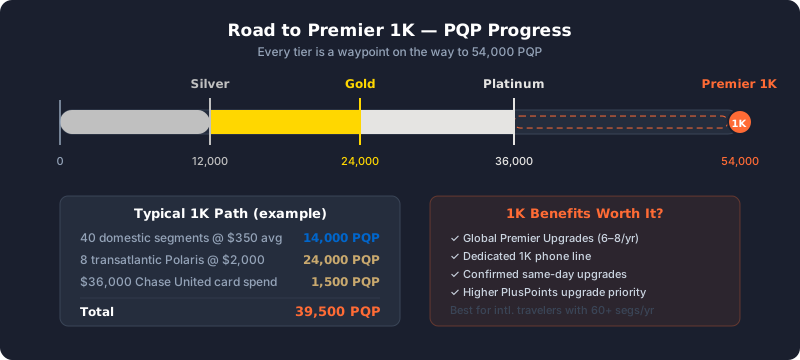
A traveler doing 40 domestic segments at $350 average base fare earns 40 × $350 = 14,000 PQP. Add 8 transatlantic segments in Polaris at $2,000 base fare: 8 × ($2,000 × 1.5) = 24,000 PQP. That's 38,000 PQP from flights. Adding $36,000 in Chase United card spending contributes 1,500 PQP. Still short of 54,000.
The point: 1K requires either very high spending on flights, a lot of flights, or a combination of long-haul business class and card spending. It's not achievable through careful routing alone — you genuinely have to spend at this level.
The 54 PQF Requirement (and the Waiver)
54 PQF is 54 individual flight segments. For a traveler doing weekly Monday-Thursday travel with connections, that's approximately 13 weeks of four-segment weeks. Achievable for a dedicated business traveler but not by a casual flyer.
The card spend waiver at $14,000 eliminates all PQF requirements. For most realistic 1K candidates, $14,000 in Chase United card spending is manageable — it averages $1,167 per month. Many business travelers running expenses through a card hit this naturally.
Enter your card spend and planned flights into the Premier 1K PQP calculator to see your combined PQP trajectory.
What 1K Actually Gives You
The benefits at 1K are materially different from Platinum, not just incrementally better.
Global Premier Upgrades (GPUs): 1K members receive GPU certificates each year — typically 6–8 depending on tenure and Premier Accelerator. GPUs can be used for confirmed upgrades to Polaris Business on international long-haul flights, cleared 24 hours before departure. One Polaris upgrade on a transatlantic route is worth $1,500–$3,000 at retail pricing.
Confirmed same-day upgrades: On select domestic routes, 1K members can receive confirmed upgrades to first class at check-in, not just waitlisted. This is the domestic equivalent of GPUs and applies broadly to most mainline United aircraft.
1K line: A dedicated phone line answered by agents with significantly more latitude to solve irregular operations problems, reroute you on full flights, and place you in premium cabins during disruptions. During major weather events, the difference between 1K service and standard Premier service is hours.
Complimentary upgrades with PlusPoints: Same as Platinum, but 1K members clear upgrades at higher priority — often clearing on flights where Platinum members didn't.
Premier Accelerator PQP bonuses: 1K members who cross PQP milestones above 54,000 receive accelerated PlusPoints awards, rewarding the heaviest flyers with more upgrade currency.
Who Should Chase 1K
The honest case for 1K is this: if you're already flying $40,000–$50,000 in base fares per year on United anyway, the incremental effort to reach 54,000 PQP is modest and the benefits are excellent. One GPU upgrade on a business trip to Europe pays for itself immediately.
If you're at Platinum and wondering whether to push for 1K, use the PQP status tracker to see how many flights the gap requires. If you're at 42,000 PQP in September, the 12,000 PQP remaining is achievable with 2–3 more international fares. If you're at 28,000 PQP in October, the math doesn't work without forcing flights you wouldn't otherwise take.
The Diminishing Return Question
Platinum versus 1K is the biggest upgrade question for road warriors. Platinum already gives you PlusPoints upgrades, a decent upgrade priority, and most of the domestic perks. 1K adds GPUs (international upgrades), a better phone line, and higher upgrade priority.
If you fly internationally frequently, 1K is a meaningful step up. If your travel is predominantly domestic, Platinum is often sufficient and the PQP gap to 1K isn't worth chasing.
Run your numbers and see where you land. For a broader view of the full status tier hierarchy, see our complete Premier status guide.