PQP vs PQF: United's Dual Qualification System
United requires both PQP and PQF for Premier status — unless you hit the card spend waiver. Here's how the two metrics work together and which one typically bottlenecks travelers.
Quick Answer
United Premier status requires both PQP (points from dollars spent on flights) and PQF (individual flight segments flown) — you need to satisfy both thresholds, unless you hit the Chase United card spend threshold that waives the PQF requirement entirely.
United's Premier status system has two separate qualifying metrics, and you need to satisfy both to earn status. Most travelers focus on PQP — Premier Qualifying Points — because it's the dollar-denominated measure that's easy to track. But PQF, Premier Qualifying Flights, trips up plenty of members who hit their PQP target only to find they're short on segments.
PQP: The Dollar Metric
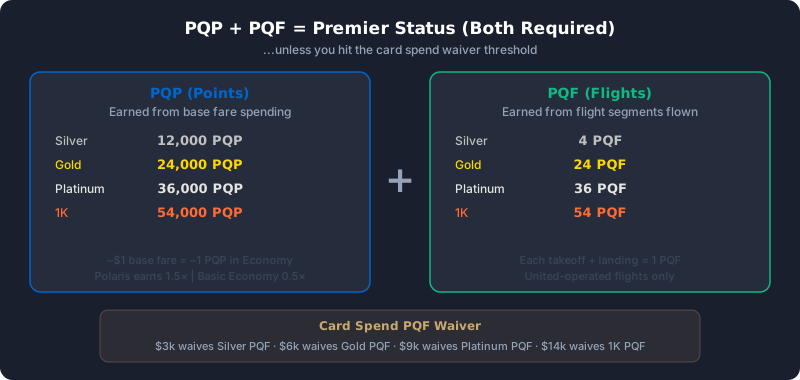
Premier Qualifying Points are earned based on money spent on United-operated flights. The formula is roughly 1 PQP per dollar of base fare in standard Economy, adjusted up or down for cabin class. Polaris Business earns 1.5 PQP per dollar; Basic Economy earns 0.5 PQP per dollar.
PQP is also earned through Chase United credit card spending — 500 PQP per $12,000 in purchases — which makes it possible to partially fund your status qualification through everyday spending.
The PQP thresholds by tier:
Premier Silver: 12,000 PQP
Premier Gold: 24,000 PQP
Premier Platinum: 36,000 PQP
Premier 1K: 54,000 PQP
PQF: The Segment Metric
Premier Qualifying Flights count the number of individual flight segments you complete on United-operated flights. Each takeoff and landing on a United or United Express aircraft counts as one PQF.
A round trip that connects through Chicago counts as 4 PQF (outbound leg 1, outbound leg 2, return leg 1, return leg 2). A nonstop round trip counts as 2 PQF.
The PQF thresholds:
Premier Silver: 4 PQF
Premier Gold: 24 PQF
Premier Platinum: 36 PQF
Premier 1K: 54 PQF
Silver's 4 PQF requirement is trivially easy to meet — even two round trips cover it. Gold's 24 PQF is where some travelers run into trouble, particularly those who fly a few long, expensive international routes per year but don't accumulate many segments.
When PQF Becomes the Bottleneck
Consider a traveler who flies two long-haul international trips per year on high-priced Polaris Business tickets. Each round trip is two segments (nonstop). That's 4 PQF for the year — enough for Silver, but not Gold's 24 PQF.
Yet that same traveler might accumulate 20,000–30,000 PQP from those two expensive tickets. They'd easily clear Gold's PQP threshold but fail on PQF. The metric that matters depends on your travel pattern.
Business travelers flying multiple short domestic hops per week — say, Chicago to Dallas every Monday and Thursday — accumulate PQF quickly but might have lower base fares. They're more likely to be PQP-bottlenecked.
The Card Spend Waiver
United allows you to waive the PQF requirement entirely if you spend enough on an eligible Chase United card:
Silver (waives 4 PQF): $3,000 in card purchases
Gold (waives 24 PQF): $6,000 in card purchases
Platinum (waives 36 PQF): $9,000 in card purchases
1K (waives 54 PQF): $14,000 in card purchases
This waiver matters most for travelers who hit PQP easily through expensive international fares or business class tickets but don't fly enough segments to meet the PQF count. Spending $9,000 on a Chase United card in a year — easily achievable by putting everyday expenses on the card — waives the 36-segment Platinum requirement entirely.
The waiver is all-or-nothing: you either hit the spend threshold and all PQF are waived, or you don't and you need every PQF the normal way. There's no partial credit.
Tracking Both Metrics
The MileagePlus app shows your PQP and PQF progress as two separate progress bars. Check both regularly, not just PQP. If you're sailing past PQP goals but lagging on PQF, you may need to add connecting flights or shorter routes to your mix.
Our United PQP calculator focuses on the PQP side of qualification — which is typically the harder metric to close for most travelers. For PQF tracking, the MileagePlus app is the best tool since it records every completed segment.
If you're planning to use the card spend waiver, enter your card spending into the calculator to see how it combines with your flight PQP toward each tier. The calculator handles the math automatically.
A Practical Planning Approach
At the start of each qualifying year, estimate both your PQP and PQF trajectories:
Count your planned United flights and multiply by average fare to estimate annual PQP
Count segments (individual legs, not round trips) to estimate annual PQF
Check whether you'll hit both thresholds for your target tier
If PQF is going to be short, decide: add connecting flights, fly more domestic hops, or hit the card spend waiver
For most road warriors flying multiple United segments per week, PQP is the binding constraint. For occasional flyers on expensive routes, PQF often determines the realistic tier ceiling — unless the card spend waiver is in play.
Understanding both metrics is the foundation of any effective Premier status strategy. See our guide to earning PQP faster once you know which metric you're optimizing for.