The Fastest Ways to Earn PQP Without Flying More
Credit card spending, fare class upgrades, and smart routing can accelerate your PQP earning significantly — here's how to maximize every dollar.
Quick Answer
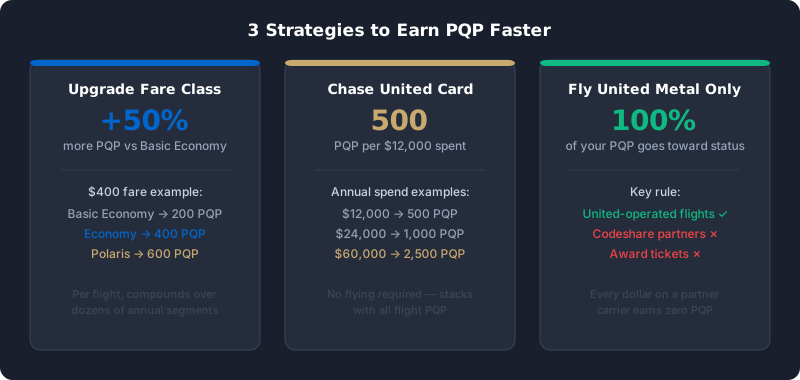
The fastest ways to earn more PQP without flying more: upgrade from Basic Economy to standard Economy (doubles your earning rate), spend on a Chase United card (500 PQP per $12,000), and fly only United-operated routes so every dollar counts.
Most MileagePlus members earn PQP the slow way: they fly Economy on whatever fare is cheapest, don't carry a United card, and wonder why they're still 8,000 PQP short of their target in October. There's a faster path. These strategies won't replace flying, but they'll make every dollar you spend work harder toward Premier status.
Strategy 1: Upgrade Fare Class, Not the Seat
This one surprises people. If you're deciding between Basic Economy at $180 and standard Economy at $220 for a domestic flight, the $40 difference buys you 90 extra PQP (from 90 to 180 PQP). Over 15 flights, that's 1,350 bonus PQP — enough to bump you a meaningful chunk toward the next tier.
Basic Economy earns at 0.5× your base fare. Standard Economy earns 1.0×. Premium Plus earns 1.25×. Polaris Business earns 1.5×. The fare class you choose is one of the biggest levers you have.
On fares where the gap between Basic Economy and Economy is small — say $20–$40 — the PQP math almost always favors standard Economy. On fares where Basic Economy saves $100+ over Economy on a cheap domestic hop, the calculus gets tighter. Run both fares through the PQP earning calculator before committing.
Strategy 2: Use a Chase United Card and Plan Your Spend
United's credit card program with Chase awards 500 PQP for every $12,000 you spend on an eligible Chase United card. That might sound modest, but it stacks. If you put $36,000 in annual spending on a United card — a realistic number for someone paying business expenses, rent, or contractors on a card — you earn 1,500 bonus PQP without boarding a single extra flight.
The cards eligible for this bonus include the Chase United Explorer card, United Quest, and United Club Infinite. The bonus is paid per $12,000 threshold crossed each calendar year, and you can hit it multiple times. There's no annual cap on the number of bonuses you can earn.
This strategy makes the most sense when you're already 3,000–5,000 PQP short of a tier and spending a few more months shifting everyday spending to the United card would bridge the gap. Plug your card spending into our PQP calculator with card bonus to see exactly how much it moves your status needle.
Strategy 3: Route Through United Hubs Instead of Flying Direct
This sounds counterintuitive, but connecting through a United hub can earn you more PQP than a direct flight in some pricing scenarios. Here's why: when you fly a connecting itinerary, each segment accrues segment minimums independently. A $200 base fare from Seattle to Newark direct earns 200 PQP. The same pricing on a Seattle–Denver–Newark routing might earn 200 PQP total, but if each segment has a meaningful base fare allocation, you're also getting two segment credits for PQF purposes.
The bigger gain comes when hub routing opens up pricing that lets you book a higher fare class. A nonstop in Economy might be unavailable in your target class, while a connecting itinerary has Premium Plus inventory open.
Strategy 4: Concentrate Your Flying on United-Operated Metal
PQP only accrues on flights operated by United or United Express. Codeshare bookings under a United flight number, but operated by Lufthansa or Air Canada, earn miles but zero PQP. If you're splitting travel between United and Star Alliance partners, every dollar spent on a partner carrier is a dollar that doesn't move your PQP balance.
When you have a choice between a United-operated flight and a Star Alliance partner on the same route at similar pricing, choose the United metal. Over the course of a year, the accumulated PQP difference can be substantial.
Strategy 5: Catch Up Before Year-End
United's PQP year runs January 1 through December 31. If you check your progress in September and realize you're 6,000 PQP short of your target, you still have time. The fastest path is usually a combination of a longer international flight (which earns 600–2,000 PQP on a single segment in Polaris) and a card spend push.
A $1,500 base fare transatlantic ticket in Polaris Business earns 2,250 PQP. A $900 base fare in Economy earns 900 PQP. If you were already planning a European trip, the upgrade math might be favorable once you factor in PQP value.
Use the United PQP status calculator in September or October to map out the fastest path to your target tier. Enter your current balance, your remaining planned travel, and your card spend to date. The calculator shows exactly how many flights — and at what average fare — you'd need.
What Doesn't Work
A few "strategies" circulate in frequent flyer forums that either no longer work or never did:
Mileage runs on cheap fares: A $79 base fare domestic mileage run earns 79 PQP. After 10 of those, you've spent $790 in fares for 790 PQP — a terrible return. Mileage runs made sense when airlines awarded miles for distance flown, not dollars spent.
Award tickets: Flights booked with MileagePlus miles don't earn PQP. The formula requires actual base fare payment.
Partner airline flights: Flying Lufthansa, Air New Zealand, or other Star Alliance partners on their own ticket earns miles, but no United PQP.
Focus on the strategies that actually work: fare class selection, concentrated card spending, and United-operated routing. For a detailed look at how United credit cards specifically contribute to PQP, see our guide to United credit cards and PQP.