How to Maximize PQP on Business Travel
Business travelers have natural advantages for earning United PQP. Here's how to structure your booking choices, card use, and routing to hit Premier status faster.
Quick Answer
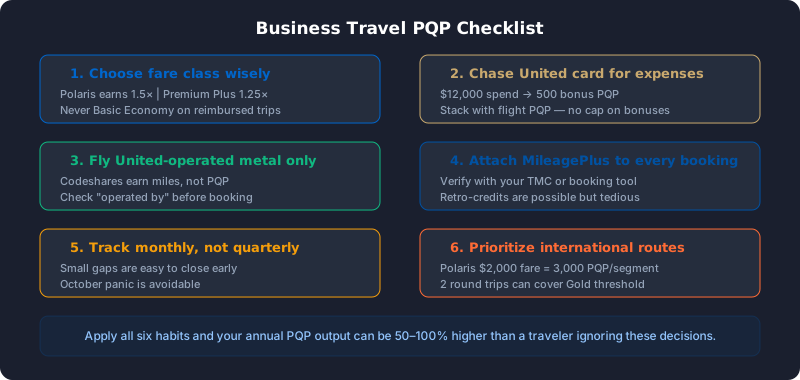
Business travelers can earn 50–100% more PQP annually by booking the highest allowable fare class, using a Chase United card for all expenses, flying only United-operated routes, and tracking progress monthly rather than scrambling at year-end.
Business travelers have an inherent PQP advantage: higher fares, more frequent flying, and often company-paid tickets. The gap between a traveler who maximizes that advantage and one who ignores it can be 10,000–20,000 PQP per year — the difference between Gold and Platinum, or Platinum and 1K.
Book the Highest Fare Class Your Company Allows
This is the single most impactful decision in your control. If your travel policy allows Business or First on flights over a certain duration, book it when you're close to a status threshold. Polaris Business earns 1.5× PQP versus Economy's 1.0×.
A $1,200 base fare in Economy earns 1,200 PQP. The same booking in Polaris Business (if available at a similar price due to corporate contracts) earns 1,800 PQP. Over 10 international segments per year, that 50% multiplier adds 6,000 PQP — roughly the difference between hitting Platinum early versus scraping by late in the year.
Even on shorter domestic routes, Premium Plus earns at 1.25× and often commands only a modest premium over Economy on corporate contracts. On a $400 base fare, Premium Plus earns 500 PQP vs. 400 PQP in Economy. Across 30 annual domestic segments, that's 3,000 extra PQP.
Always Avoid Basic Economy on Company Travel
Basic Economy fares earn at 0.5× — half of standard Economy. When you're not paying for the ticket yourself, there's often no reason to book Basic Economy. Check your company's travel policy to see if Economy fares (not Basic Economy) are allowed, and book accordingly.
If your booking tool auto-selects the cheapest option and that's Basic Economy, flag it. Paying $20–$40 more per ticket for standard Economy doubles your PQP per segment — and on 40 annual flights, the compounding is significant. Use the PQP calculator to see the gap on your typical fare.
Keep the Ticket in Your Name, in Your MileagePlus Account
This sounds obvious, but corporate travel tools sometimes book tickets in the company account or under a generic traveler profile. PQP only credits to your personal MileagePlus account. Make sure your MileagePlus number is attached to every booking, not just when you remember.
If your company uses a travel management company (TMC), confirm they have your MileagePlus number on file and that it's applied automatically. Retro-credit claims for missing PQP are possible but tedious — it's far easier to ensure proper credit upfront.
Use a Chase United Card for All Non-Reimbursed Business Expenses
If you're paying out-of-pocket for meals, ground transport, conference fees, and other travel expenses, run those through a Chase United card. The 500 PQP per $12,000 bonus stacks with flight PQP.
A business traveler spending $2,000/month on expensable costs that go through a personal card — $24,000 per year — earns 1,000 bonus PQP from that spending alone. That's meaningful toward any status tier. If your employer reimburses you and you're putting expenses on a personal card before the reimbursement comes through, switching to a United card captures PQP you're currently leaving behind.
Strategic Connecting Flights for PQF Accumulation
If you're close on PQF but have met your PQP target, routing connecting through a United hub rather than taking a nonstop adds PQF without adding cost. This is particularly relevant for travelers targeting 1K (54 PQF) who fly a small number of expensive routes.
Adding a Chicago, Newark, Houston, or Denver connection to a domestic itinerary turns 2 PQF into 4 PQF for the round trip. If the fare is similar, the routing choice costs you nothing except some connection time.
Track Your Progress Monthly, Not Quarterly
The traveler who checks their PQP balance once per quarter often discovers in October that they're 12,000 PQP short — a recoverable gap, but stressful to close. Monthly tracking surfaces gaps early when they're small and easy to address.
Check the MileagePlus app monthly and cross-reference with a forward projection using the PQP status tracker. Enter your remaining planned trips and your card spend to date. The calculator shows exactly where you'll land by year-end and whether you need to adjust anything.
International Routes Earn the Most PQP Per Dollar
For business travelers with international travel, these are the most PQP-efficient bookings you make. A $2,500 base fare transatlantic trip in Polaris Business earns $2,500 × 1.5 = 3,750 PQP from one round-trip segment (two segments, so 3,750 PQP per segment × 2 = 7,500 PQP total). Two such trips per year is 15,000 PQP — 42% of the Platinum threshold — from just four segments.
If your role involves quarterly travel to Europe or Asia, you're starting each year with a significant PQP base before you fly a single domestic segment. For a detailed look at how international fare earnings stack up, see our guide to PQP per flight by route type.
Combine all these strategies, and business travel that was already happening becomes a well-tuned Premier status machine. The PQP doesn't cost you anything extra — it comes from being intentional about the choices you already have.