How Much PQP Do You Earn Per Flight?
PQP earnings depend on your base fare, cabin class, and route type. Here's exactly how United calculates PQP for every ticket you buy.
Quick Answer
You earn roughly 1 PQP per dollar of base fare in standard Economy — Basic Economy earns half that (0.5×) while Polaris Business earns 1.5×, subject to route minimums of 4 PQP domestic, 6 short-haul international, and 8 long-haul international.
Plenty of United flyers track their miles but ignore their Premier Qualifying Points until January panic sets in. By then, they're short 5,000 PQP with three weeks left in the year. Understanding how PQP accrues on each flight — before you book — is the difference between hitting Platinum and settling for Silver.
The Basic Formula: Dollars Times a Multiplier
United awards PQP based on the base fare you pay, multiplied by an earning rate that depends on your cabin class. The formula is:
PQP = base fare × multiplier (at least the route minimum)
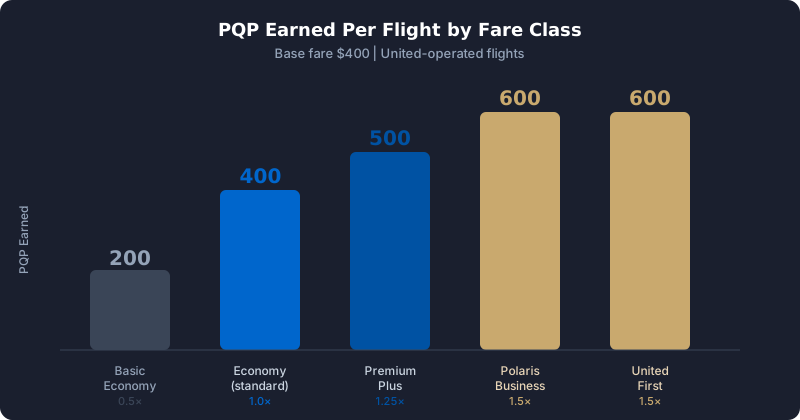
The multipliers by cabin class are:
Basic Economy: 0.5× (50% of base fare)
Economy (standard): 1.0×
Premium Plus: 1.25×
Polaris Business: 1.5×
United First: 1.5×
A $400 base fare in Economy earns 400 PQP. That same fare in Basic Economy earns just 200 PQP. In Polaris Business, it earns 600 PQP. The difference is real and compounds across a full year of flying.
Route Minimums — When They Apply
Every flight has a PQP minimum regardless of the ticket price. These floors kick in when your base fare is very low:
Domestic flights minimum 4 PQP per segment
Short-haul international (Canada, Mexico, Caribbean, Central America): minimum 6 PQP
Long-haul international (Europe, Asia, South America, Africa): minimum 8 PQP
If you book a $5 base fare domestic ticket (rare, but it happens with certain awards or error fares), you'd earn 4 PQP instead of $5 × 1.0 = 5 PQP. For anything above $8 in Economy on a domestic route, the formula just runs as normal.
Real Earning Examples
Let's walk through five common scenarios.
Scenario 1: Chicago to Denver, Economy, $220 base fare.
$220 × 1.0 = 220 PQP. Well above the 4 PQP domestic minimum. Result: 220 PQP.
Scenario 2: New York to Los Angeles, Basic Economy, $180 base fare.
$180 × 0.5 = 90 PQP. Result: 90 PQP. You'd have earned 180 PQP in regular Economy for the same flight.
Scenario 3: Houston to London, Polaris Business, $1,800 base fare.
$1,800 × 1.5 = 2,700 PQP. Route minimum is 8 — easily cleared. Result: 2,700 PQP from one round-trip segment.
Scenario 4: San Francisco to Tokyo, Economy, $650 base fare.
$650 × 1.0 = 650 PQP. Long-haul international minimum is 8. Result: 650 PQP.
Scenario 5: Newark to Toronto, Economy, $60 base fare.
$60 × 1.0 = 60 PQP. Short-haul international minimum is 6. Result: 60 PQP.
Use our United PQP calculator to run your specific fare before booking — it'll tell you exactly how much each flight contributes toward your target status.
Why Base Fare Matters More Than Total Price
This is the most common confusion: people enter the total ticket price they paid and wonder why their PQP looks wrong in the MileagePlus app. The $723 on your credit card statement includes taxes, government fees, and airport charges that United never sees. None of those dollars earn PQP.
Your base fare is typically visible on the confirmation email as a separate line item. It's also shown during the checkout process before taxes are added. On a domestic fare where the total is $280, the base fare might be $170–$220 — the rest is fees.
For international routes, taxes can be substantial. A $900 transatlantic ticket might have a $400 base fare and $500 in UK Air Passenger Duty, US departure fees, and fuel surcharges. You'd earn PQP on $400, not $900.
How Stopover Routing Affects Your Earnings
Each segment of a connecting itinerary earns PQP independently. If you fly Chicago to Denver to Los Angeles, that's two segments, each earning PQP on their own base fare allocations. The airline splits the total base fare between segments based on the distance or yield of each leg.
This is actually why hub-and-spoke routing can earn more PQP than direct flights in some cases — you're accumulating segment minimums on each leg, and the fare may be split more favorably.
Codeshare vs. United-Operated Flights
PQP only accrues on United-operated flights, not codeshare partners. If you book a United flight number but the aircraft is operated by Lufthansa or Air Canada, you'll earn miles but not PQP toward United Premier status. Always check the "operated by" field when booking.
Star Alliance Gold partners like Lufthansa Senator and Swiss Senator status holders enjoy United Gold benefits when flying United, but they're earning their own program's equivalents — not United PQP.
Using the Calculator for Forward Planning
The most valuable use of PQP math isn't recalculating past flights — it's planning future ones. Before booking a fare, run it through the PQP earning calculator to see how it moves your status needle. A $600 Business upgrade on a route you'd normally fly Economy could add 300 extra PQP. Over four or five such flights, that's the difference between Gold and Platinum.
Check what tier you're targeting and work backwards. If Gold requires 24,000 PQP and you're at 18,000, you need 6,000 more. At an average domestic Economy yield of about 300 PQP per flight, that's roughly 20 more flights — or 4 international business fares. The calculator handles that math automatically.
Common Questions About PQP Calculations
Do I earn PQP on award tickets? No. Flights booked with miles or using upgrade awards don't earn PQP. The PQP formula is based on the cash (or cash-equivalent) base fare paid.
What about United upgrade certificates? If you use a Global Premier Upgrade certificate to upgrade from an Economy paid fare to Business, you earn PQP on the original Economy base fare. You don't lose the PQP — you just don't earn extra for the upgraded cabin.
Does booking class (A, B, C, etc.) affect PQP? No. Unlike some other loyalty programs, United PQP is purely fare-based. The booking inventory code doesn't change your earning rate — only your fare class (Basic Economy, Economy, etc.) does.
Understanding these mechanics puts you in control of your status trajectory. Check your current progress, then estimate your next flight's PQP contribution before you commit to a booking. Small decisions — like avoiding Basic Economy on a $400 fare — add up to hundreds of PQP by December.